

 Military & Government
The 3 Eras of Cybersecurity Training
Cybersecurity training has always evolved in response to the threats organisations face. As attack techniques became more sophisticated, defenders were forced to adapt not only their technologies but also the way they developed talent. The result has been a gradual shift from individual knowledge acquisition toward continuous, team-based readiness.
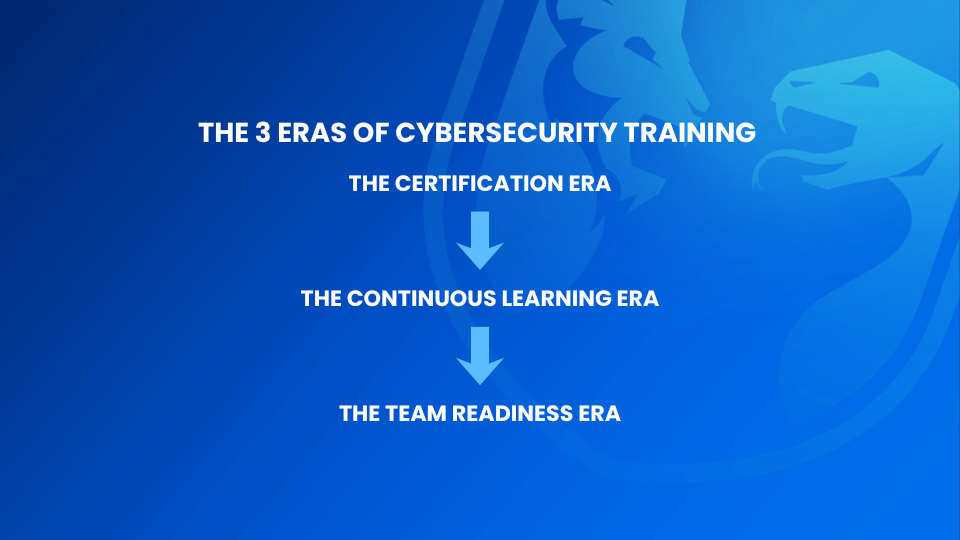
The Certification Era: All About Individual Expertise
For many years, cybersecurity training focused primarily on the individual. Certifications, bootcamps, and instructor-led courses were the gold standard for validating knowledge and building technical skills. Programs such as CISSP, CISM, OSCP, and vendor-specific certifications helped establish a common baseline of competence across the industry.
This approach was highly effective in an era when security roles were more specialised, and threats evolved at a relatively manageable pace. Organisations invested in individual development because success often depended on the expertise of specific analysts, engineers, or incident responders. The goal was straightforward: build skilled professionals who could apply their knowledge when incidents occurred. While certifications and formal training remain valuable today, they were largely designed to measure what an individual knows rather than how a team performs under pressure.
The Continuous Learning Era: Keeping Pace with Change
As cyber threats accelerated, organisations began to recognise the limitations of episodic training. New attack techniques, emerging vulnerabilities, and rapidly evolving threat actors meant that knowledge acquired during a certification course could become outdated within months.
This challenge gave rise to continuous learning models. Organisations increasingly adopted online learning platforms, subscription-based training, and role-based development programs that provided ongoing access to updated content. Rather than treating training as a one-time event, companies began viewing it as a continuous process of skill maintenance and improvement.
The Team Readiness Era: Preparing for AI-Driven Threats
Now, cybersecurity is entering its next stage of evolution. Artificial intelligence is transforming both attack and defence, enabling threat actors to automate tasks that once required significant time and expertise.
Individual expertise remains essential, but it is no longer sufficient. Cyber incidents rarely succeed or fail because of a single analyst's decision. Instead, outcomes depend on how effectively teams communicate, share information, coordinate actions, and adapt to changing conditions.
This reality is reflected in recent workforce development trends. Training consumption data show organisations are increasingly investing in team-based learning programmes rather than standalone courses. What began as a discipline centred on technical expertise is becoming one centred on operational readiness. In the age of AI, the most effective defence is not simply a well-trained analyst; it is a well-trained team.
Why Should Organisations Invest in Team-Based Training?
As cyberattacks become increasingly AI-driven, organisations know that resilience depends on the collective performance of their security teams rather than the expertise of individual contributors alone.
Recent training consumption trends support this transformation. Analysis conducted by Infinity Global Services between 2023 and 2025 revealed a significant decline in individual course purchases alongside a sharp increase in team-based training.
Several factors are driving this change.
- Team-based learning helps establish a common operating language across the Security Operations Centre (SOC). Shared frameworks, investigation techniques, escalation procedures, and communication standards improve coordination and reduce the likelihood of misunderstandings during active incidents.
- The cybersecurity profession continues to face significant workforce challenges. Security teams are expected to manage growing workloads, monitor increasingly complex environments, and respond to a constantly evolving threat landscape. The result is often high levels of stress and burnout. Investing in team development can help address these challenges.
- Modern cyber defence is fundamentally a team activity. The true measure of readiness is not whether a single analyst knows the correct answer, but whether an entire team can identify a threat, coordinate a response, communicate effectively, and contain an incident before significant damage occurs.
What Effective Cybersecurity Training Looks Like Today
Knowledge and collaboration must ultimately be tested in practice. Cyber defence exercises provide the bridge between learning and performance by placing teams in realistic scenarios that mirror the challenges they are likely to encounter in the real world.
Unlike traditional training, exercises focus on decision-making, communication, coordination, and execution. They allow organisations to evaluate how teams perform under pressure, identify weaknesses in processes and procedures, and reinforce best practices through experience.
As AI-enabled attacks become more prevalent, exercises should increasingly incorporate scenarios involving AI-generated phishing campaigns, deepfake impersonation, compromised AI assistants, prompt injection attacks, and other emerging threats. This allows teams to develop familiarity with attack patterns they may soon encounter in production environments.
AI is reshaping cybersecurity on both sides of the battlefield. While technical expertise remains essential, modern cyber resilience depends on something larger: the ability of teams to work together, adapt quickly, and respond effectively under pressure.
Ready to assess and strengthen your team's readiness for modern cyber threats? CDeX enables organisations to run realistic cyber defence exercises that test skills, improve coordination, and build the confidence needed to respond when it matters most. Explore how CDeX can help your team turn training into measurable cyber resilience.
Table of contents